The FROID differentiator
A retrieval-augmented AI assistant (LLM-RAG) that answers, in clinical language, everything the professional needs to explore the platform's capabilities during the session — and that cross-references your patient roster with the global anonymous Data-Froid.
See it in action
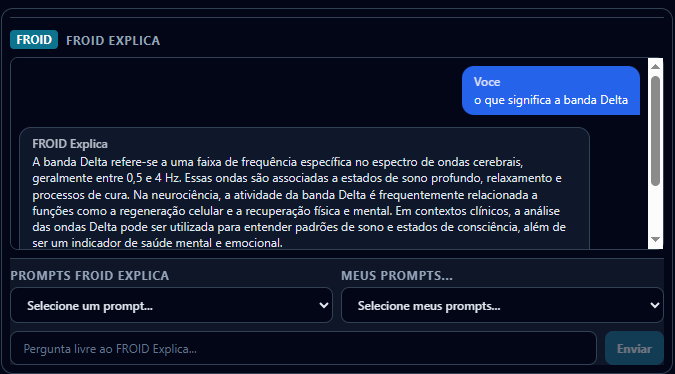
A real example of the interface: the professional asks a question and FROID Explains answers, with grounding, about the session's reading — with selectors for pre-configured prompts and custom prompts.
How it works
FROID Explains decides, for every question, whether it is about knowledge (how to interpret the reading) or about data (how this patient compares to the base) — and routes it to the right engine.
Retrieval-augmented generation (RAG) over FROID's verified knowledge base: 12 Zones, IPM, IDM, biomarkers, FACS, and the scientific bibliography. Answers "what does this dissonance mean?" with grounding — always about already-calculated metrics, never generating the acoustic values.
Data-Froid supports aggregate queries over eligible records. The current record count is not measured on this page. It does not provide other people’s individual clinical records. Missing measurements are not zero; queries depend on database availability and the server’s cohort threshold.
Data-Froid supports aggregate queries over eligible records. The current record count is not measured on this page. It does not provide other people’s individual clinical records. Missing measurements are not zero; queries depend on database availability and the server’s cohort threshold.
This and other proprietary algorithm definitions are documented in internal references consulted by the RAG engine — e.g., FROID_Estabilizacao_Clinica_Da_Tela.md, which records the metric, the weighting math, and the module's clinical rationale.
Language engine built on state-of-the-art models (e.g., Gemini / GPT-4o), with safety verification on every response. Architecture details in Technology and privacy in Security.
Portfolio intelligence
Data-Froid supports aggregate queries over eligible records. The current record count is not measured on this page. It does not provide other people’s individual clinical records. Missing measurements are not zero; queries depend on database availability and the server’s cohort threshold.
Ask Explains to relate metrics, speech, and sessions: how a recurring dissonance speaks to a specific theme, how the recommendation given in one session echoes in the next, what brings two seemingly distinct cases together. It raises association hypotheses for your judgment — never a diagnosis.
Locate patterns that appear only in the aggregate: sustained IPM drops, responses that repeat across similar profiles, evolution across sessions. The comparison strictly respects access controls — in multi-professional clinics, each person sees only the patients the administrator authorized.
Turn those findings into your own conduct: protocols, intervention sequences, and follow-up criteria tuned to your cases. It's the path for your clinic to differentiate itself in approach and in patient recovery — building, session after session, a method with your signature.
FROID Explains is decision support: it organizes signals and raises hypotheses for the qualified professional, without replacing clinical assessment. Every data cross-reference respects organizational segregation and the access controls described in Security and Ethics.
Examples aligned with current capabilities. Answers depend on the supplied context, measured data and database availability. There is no validated individual treatment prediction model. Automatic, manual and final segments can have different durations.
In Settings, save a question title and its text. Personal prompts are stored in the current browser, separated by professional email. This feature does not provide confirmed cross-device synchronization.
Data-Froid supports aggregate queries over eligible records. The current record count is not measured on this page. It does not provide other people’s individual clinical records. Missing measurements are not zero; queries depend on database availability and the server’s cohort threshold.
See the interactive demo or talk to the team about a pilot.