Prepare the session
Check the authorizations; camera and microphone are enabled by the browser when the room is opened. The initial reference is vocal, not an individual normalization of the face.
FROID Psique · Professionals and clinics
FROID organizes vocal measures and facial movements during the session for consultation and review. A support for observation, without requiring the professional to turn every signal into a conclusion.
Check the authorizations; camera and microphone are enabled by the browser when the room is opened. The initial reference is vocal, not an individual normalization of the face.
Vocal measures and facial patterns appear in distinct channels. The current reading is distinguished from the history; a missing measure is declared.
Use the available records, the transcript and your own notes to revisit the session. Confirm AI-assisted content before incorporating it into the assessment.
At the end of the session, the report gathers the statistical reading of each cut, with the baseline as reference.
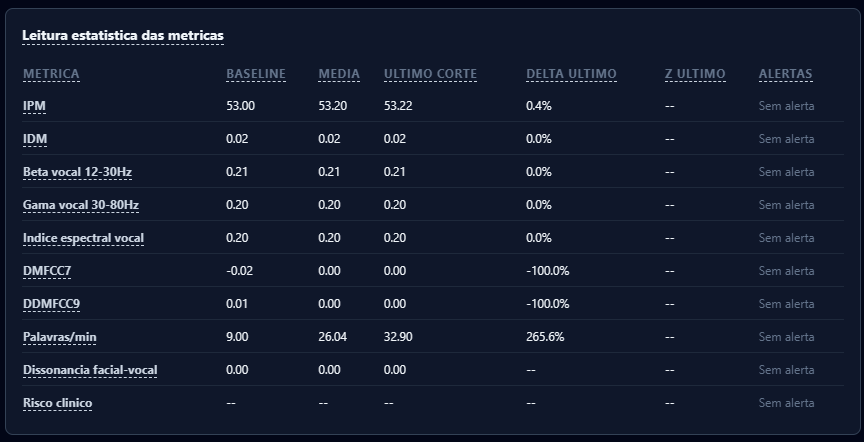
Think of an instrument panel: each indicator describes one dimension. Interpretation requires knowing the journey — here, the patient's conversation, history and assessment.
IPM and IDM summarize acoustic deviations. Seven families describe compatible facial configurations, not proven feelings. FROID does not measure facial-vocal dissonance.
FROID Explains helps discuss the measures and records available. Ready-made questions offer a starting point; your own prompts let you direct the query to the interval and purpose of the analysis.
The purpose of the archive is to support aggregate queries and studies on patterns, subject to data eligibility and privacy controls. Growth of the database does not replace clinical validation.
The V2 model separates analysis credits from the organizational license. Independent professionals use credits; clinics with a team have a license sized by active clinical professionals. Check the terms before purchasing.
Talk to the team about features, permissions, data processing and implementation in your practice.
Support for observation, not diagnosis or automated therapeutic decision. Read the limits.